Phone:
+8618098949445
Physical address:
604, Building 1, Sanyu Industrial Park, Xinwei Fourth Industrial Zone, Xinzhuang Community, Majan Street, Guangming District, Shenzhen

Phone:
+8618098949445
Physical address:
604, Building 1, Sanyu Industrial Park, Xinwei Fourth Industrial Zone, Xinzhuang Community, Majan Street, Guangming District, Shenzhen

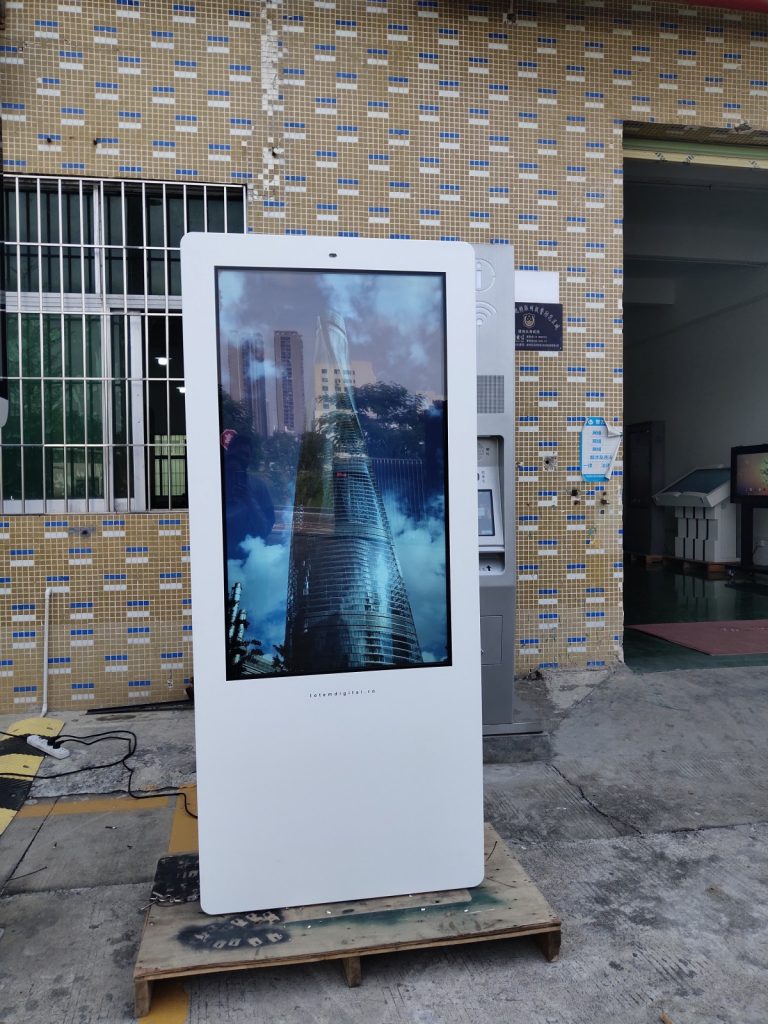
An outdoor LCD advertising kiosk is a digital terminal deployed in exterior environments to broadcast multimedia information via liquid crystal display panels. Distinct from traditional static lightboxes or indoor commercial screens, it requires specialized engineering designed specifically to conquer harsh outdoor physical environments. Examining its technical architecture and deployment domains reveals that outdoor digital signage has evolved into an indispensable medium for urban commercial advertising and public communication.
Outdoor environments subject electronics to severe challenges: washed-out visibility caused by intense solar radiation, component failures triggered by extreme temperature fluctuations, and structural corrosion induced by driving rain and atmospheric dust. To resolve these vulnerabilities, outdoor digital signage incorporates several essential technical configurations.
Optical Display Architecture: Standard commercial LCD panels exhibit severe solar wash-out under intense sunlight, rendering graphics unreadable. Outdoor kiosks utilize ultra-high-brightness LCD panels that boost LED backlight luminance to counteract intense ambient light, preserving crisp legibility in full sunlight. Simultaneously, the screen face is fitted with anti-reflective (AR) tempered glass that diffuses ambient surface reflections, preventing mirror-like glare from obscuring displayed content.
Integrated Thermal Climate Control: Internal climate management is critical for operational stability. Outdoor ambient temperatures experience drastic shifts; under direct summer solar radiation, internal chassis temperatures can surge rapidly, risking liquid crystal isotropic clearing (black spots) or controller failure. Modern outdoor kiosks deploy integrated thermal solutions, including smart variable-speed convective fan cooling, industrial air conditioning, or air-to-air heat exchangers. Embedded temperature sensors monitor internal conditions in real time, automatically activating cooling and modulating fan RPM. In cold regions, internal heating elements are incorporated to guarantee cold-boot reliability in sub-zero winters.
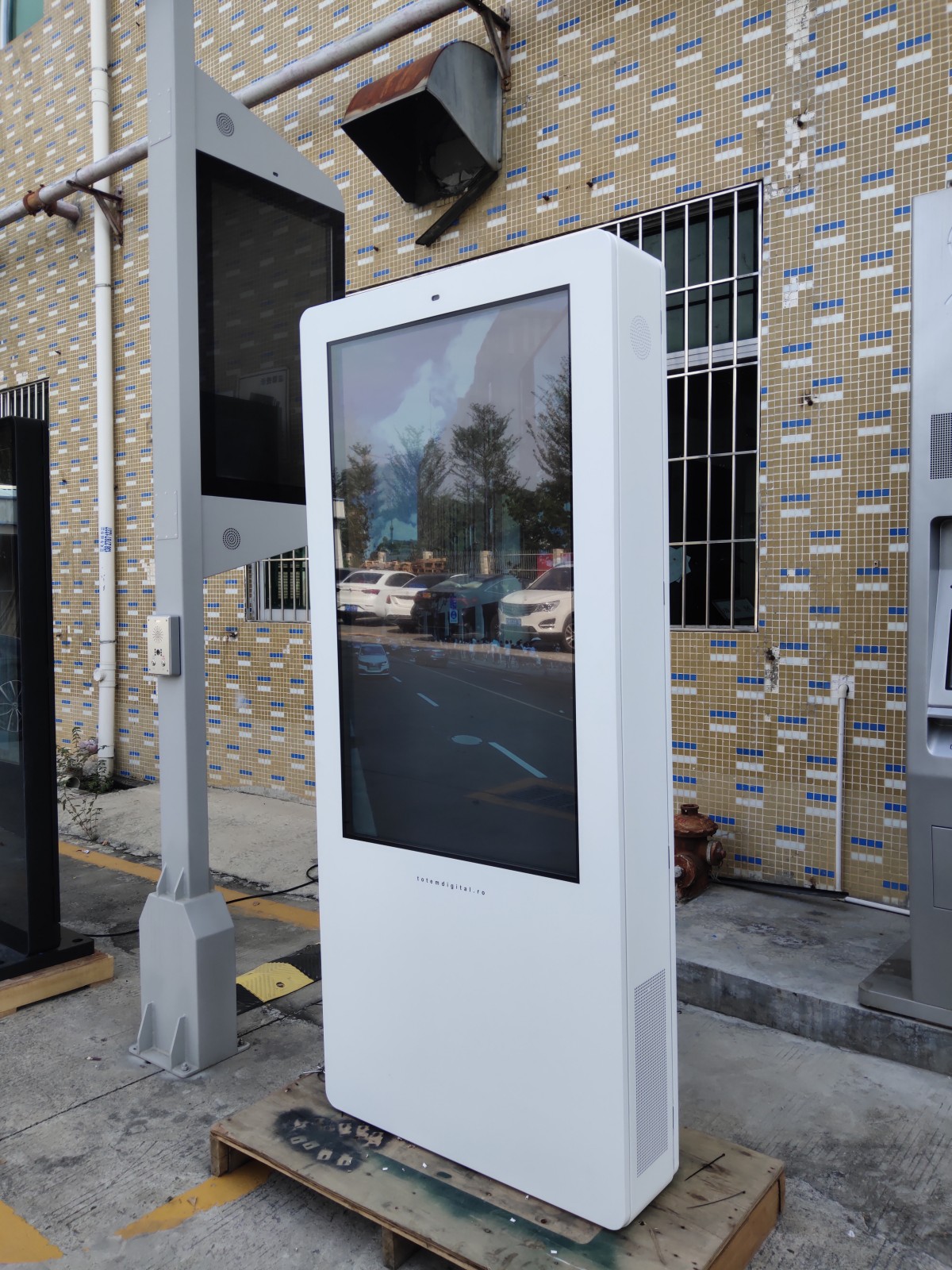
Enclosure Protection and Sealing: Durability relies on rugged chassis construction and precision gasket seals. Outer enclosures are fabricated from galvanized steel or extruded aluminum alloy, treated with multi-stage anti-corrosion powder coatings to withstand acid rain and coastal salt spray. Complete systems achieve certified IP65 ingress protection, ensuring total dust-tight sealing and resistance against low-pressure water jets from any direction for reliable all-weather operation.
As information terminals, the commercial value of outdoor kiosks centers on reliable media scheduling and agile content updates. Early displays relied on standalone USB playback loops requiring manual on-site card swapping. Modern outdoor digital signage integrates wired and wireless networking as standard.
Through cloud CMS platforms, operators can centrally push multimedia playlists, configure daypart schedules, and automate system power timers from a centralized command center. This centralized architecture drastically lowers maintenance overhead while maximizing promotional agility, enabling immediate broadcast updates for transit advisories and flash retail sales.
Furthermore, many outdoor kiosks feature embedded ambient optical sensors that automatically modulate backlight output according to real-time ambient illumination. The display maintains high brightness in daytime sunlight while dimming automatically at dusk and night, conserving energy while preventing nighttime light pollution.
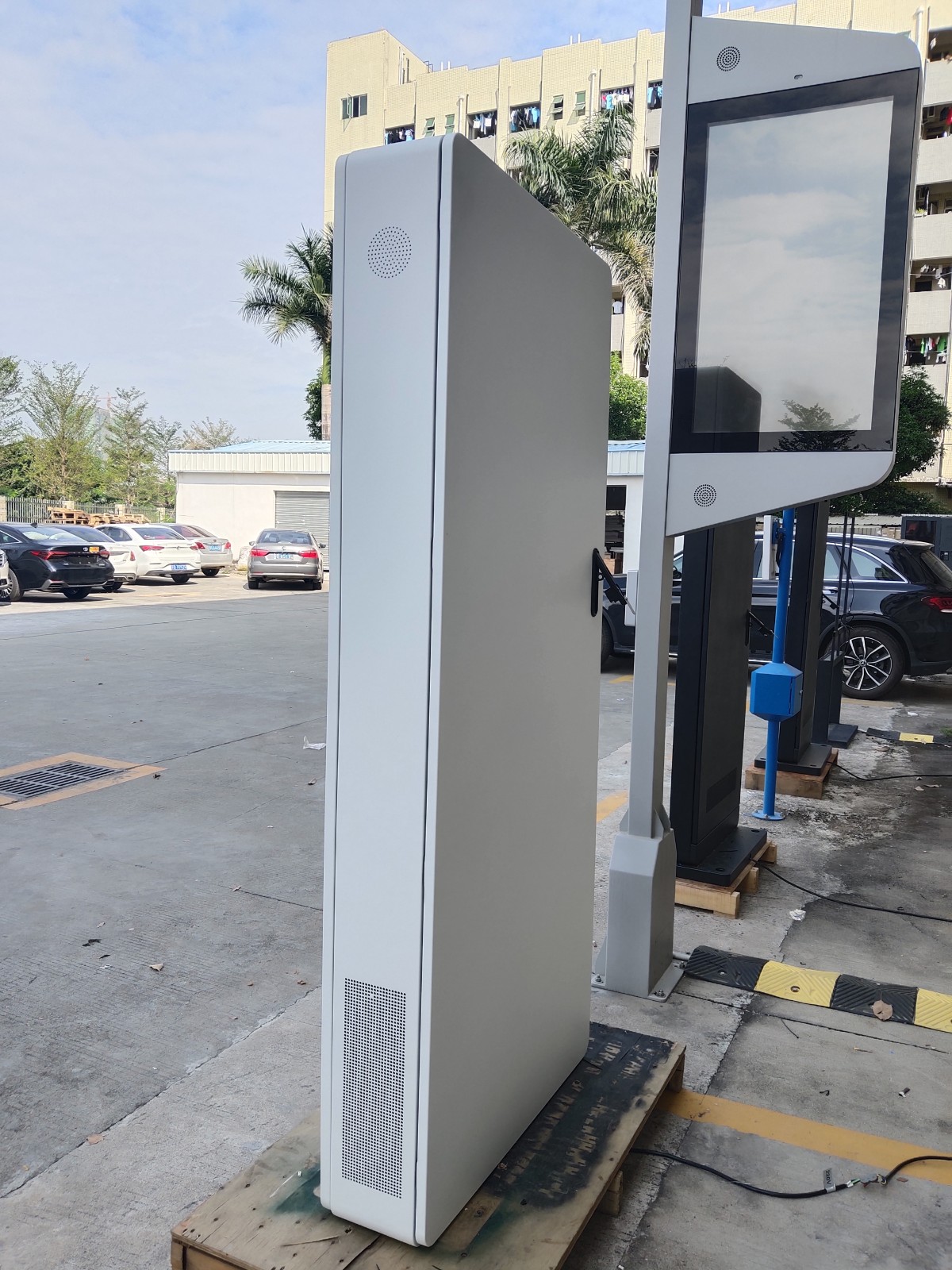
Outdoor kiosks feature diverse physical form factors adapted to specific installation sites, including freestanding pedestals, wall-mounted displays, and bracket-hung enclosures. Freestanding kiosks are typically placed along commercial pedestrian boulevards, park atriums, or community gates for wayfinding and brand marketing. Wall-mounted and bracketed models mount along bus shelters, metro station portals, and building facades where ground footprint is constrained.
Application sectors span wide commercial and civic realms: transit hubs (airports, railway stations, subway stations) broadcast timetables and passenger guidance; retail shopping centers promote tenant brands and promotional sales; and parks and residential communities broadcast civic notices, public health alerts, and municipal announcements.
From a technological perspective, outdoor kiosks are evolving from passive one-way broadcast screens into multifunctional interactive public terminals. Advanced units integrate interactive capacitive touch overlays, allowing citizens to navigate local maps and municipal service directories. Display-wise, 4K ultra-high-definition panels and wide-gamut optical backlights are seeing widespread adoption, delivering unprecedented visual depth and color richness.
Overall, the expansion of outdoor LCD signage is propelled by ongoing smart city informatization. It fulfills commercial brands’ demands for precision marketing while providing public authorities with a dependable communication channel. As technology matures, outdoor digital displays will assume increasingly multifaceted roles across contemporary urban public spaces.
If you are sourcing high-reliability outdoor digital signage hardware, consider these commercial specifications:
ZXTLCD provides comprehensive ODM/OEM manufacturing for outdoor displays—including sunlight-readable brightness up to 4000 nits, IP65/IP66 weatherproof enclosures, intelligent temperature management, and integrated remote CMS.