Phone:
+8618098949445
Physical address:
604, Building 1, Sanyu Industrial Park, Xinwei Fourth Industrial Zone, Xinzhuang Community, Majan Street, Guangming District, Shenzhen

Phone:
+8618098949445
Physical address:
604, Building 1, Sanyu Industrial Park, Xinwei Fourth Industrial Zone, Xinzhuang Community, Majan Street, Guangming District, Shenzhen

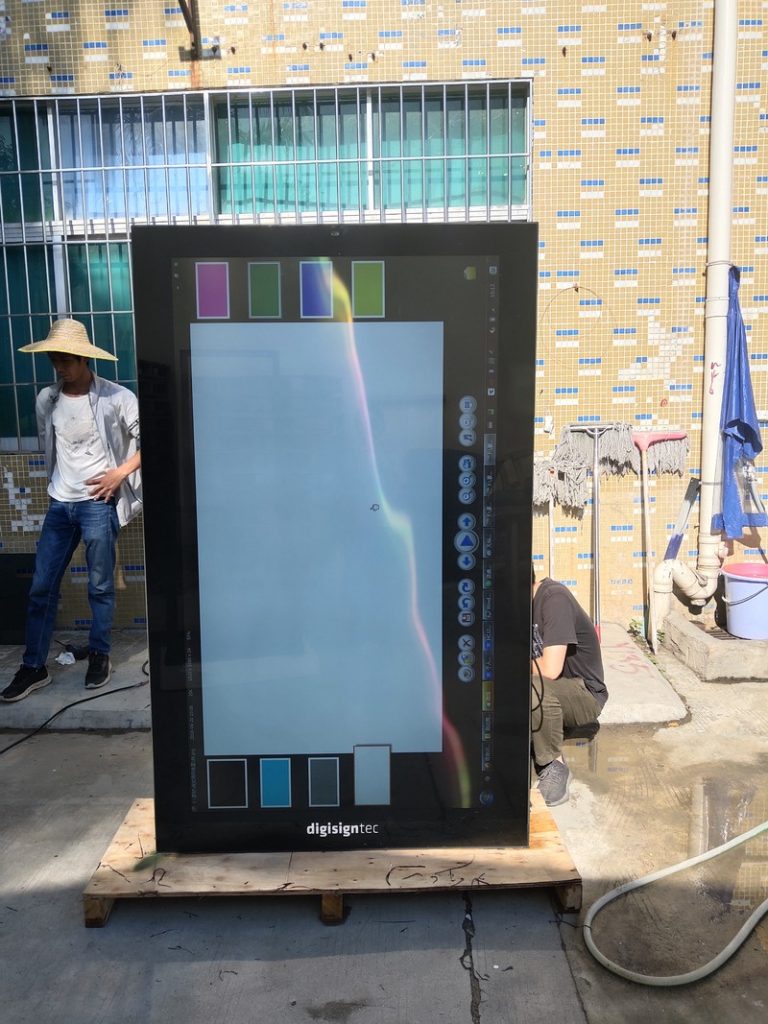
Consultations with commercial clients preparing to purchase floor-standing digital signage kiosks consistently center on a familiar set of inquiries. Compiling and clarifying these five most frequently asked questions prior to requesting supplier quotations will save significant time and streamline procurement.
Many buyers instinctively assume ‘the bigger the better,’ but optimal diagonal sizing depends on viewing distances and spatial clearances.
Screen size is dictated primarily by how far away patrons stand. For touchpoints viewed within three to six feet—such as boutique storefront entrances or checkout counters—small-to-medium diagonals (32 to 43 inches) provide ample visual impact. For spacious hotel atriums and mall concourses viewed from twenty to thirty feet away, larger displays (55 to 65+ inches) are required for long-distance legibility.
Simultaneously, evaluate physical spatial footprint: entrance width, walkway clearance, ceiling heights, and foot-traffic density. Floor-standing kiosks feature integrated pedestals and metal housings, occupying greater floor space than the bare screen diagonal suggests. Always measure target floor clearances before selecting dimensions.
If floor space is particularly narrow, or if displays must integrate into retail shelving, columns, or architectural niches, consider ultra-wide stretched bar LCD displays, which can be custom-sized to fit irregular spatial contours far more naturally than standard rectangular totems.
This represents the most critical specification checkpoint, and the most common source of procurement errors.
Under standard indoor commercial lighting, standard luminance (350 to 500 nits) is completely sufficient. However, if kiosks are positioned adjacent to glass facades, storefront doors, or sunny display windows, higher brightness (700 to 1,500 nits) is required to prevent washed-out daytime visuals.
For genuine outdoor environments exposed to weather, displays require full all-weather engineering: high brightness (2,000–3,000 nits), certified IP65 weatherproofing, active thermal cooling, and wide-temperature components. Outdoor kiosks and indoor kiosks are distinct hardware categories; never deploy indoor units outdoors to save money, as moisture shorts and thermal failure will quickly follow. Clearly detail your installation environment to suppliers to receive appropriate recommendations.
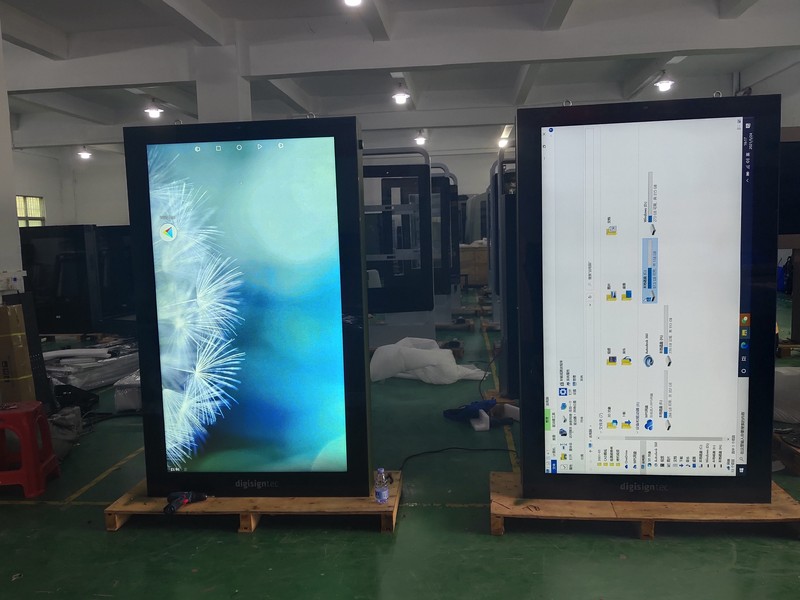
Operating system and software architectures dictate day-to-day administrative ease.
First, evaluate the OS platform: Android systems are lightweight, cost-effective, and ideal for standard video and image loops; Windows embedded systems offer broader peripheral compatibility for proprietary enterprise software and complex interactive applications. Choose the system that matches your content workflow rather than defaulting to complex setups.
Second, evaluate content updating methods: For one or two isolated kiosks, local USB drive updates may suffice. For multi-unit, multi-location deployments, cloud-networked digital signage CMS solutions are essential, enabling centralized remote publishing, daypart scheduling, and automated power timers from any browser. Confirm network connectivity options (Wi-Fi, 4G, or Ethernet).
Additionally, clarify supported media file formats, canvas aspect ratio formatting, and whether software licenses involve recurring subscription fees.
For the exact same ’55-inch Floor-Standing Kiosk’ label, market quotations can differ by several multiples, creating confusion for buyers.
The price gap reflects authentic component differences: LCD panel grading (original A-grade commercial vs. recycled/B-grade consumer glass), backlight nit ratings, motherboard processors and RAM/storage, chassis sheet metal gauge, 24/7 commercial duty cycle ratings, included CMS software licenses, and warranty duration.
When comparing quotes, look beyond the bottom-line price and demand itemized specifications: panel origin, luminance, computing specs, metallurgy, factory burn-in validation, software terms, and warranty coverage. Abnormally cheap quotes typically mask stripped components or hidden post-sale charges. In commercial hardware, evaluate Total Cost of Ownership rather than sticker price alone.
Logistics and support are frequently overlooked, yet cause the greatest frustration when issues arise.
Freight Transit: Large commercial screens are vulnerable to impact and vibration; confirm wooden crate packaging standards and clarify shipping damage liability. Always inspect packaging and document damage upon delivery.
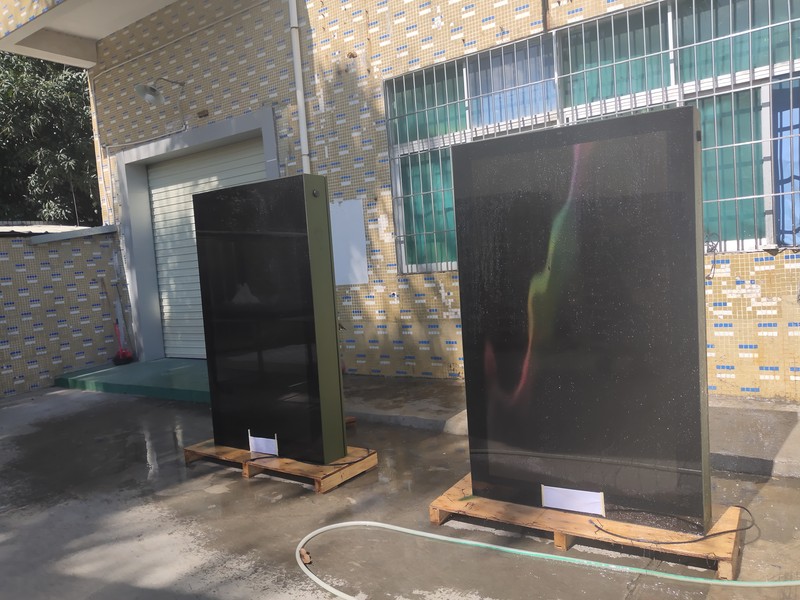
Physical Installation: Floor-standing kiosks must be positioned securely, using floor anchor bolts in crowded venues to prevent accidental tipping. Verify AC power drops and network connectivity in advance, and confirm whether suppliers provide remote installation guidance or on-site commissioning.
After-Sales Warranty: Clarify warranty duration, covered components, response turnaround times (remote vs. on-site), and spare parts availability. Crucially, insist on formalizing these SLAs in binding purchase agreements.
Before requesting formal quotations, assemble a concise project brief: exact installation location and available floor clearance; indoor, window-facing, or outdoor exposure; target media content formats; unit counts; cloud networking requirements; budget parameters; and warranty SLA expectations.
A clear brief ensures suppliers deliver accurate, tailored proposals, facilitating straightforward comparison.
How many units should first-time buyers order? Procuring an initial evaluation sample unit to verify display fidelity, software workflow, and operational reliability is recommended before committing to volume rollouts.
Do buyers need in-house graphic designers to create content? Simple graphic banners and promotional videos can be authored internally or via external agencies. Regardless of creator, creative media assets must be formatted strictly to native screen resolution to avoid distortion.
Can floor-standing kiosks be customized? Yes. Sizing, chassis colors, and interactive features can be tailored through manufacturer consultation. ZXTLCD specializes in custom LCD stretched bar displays, engineering elongated screens to fit specific spatial contours if standard totems do not suit your layout.
Procuring floor-standing digital signage boils down to five essentials: matching screen size to viewing distance, selecting appropriate brightness for the environment, deploying manageable software, auditing itemized quotations, and formalizing dependable warranty SLAs. Addressing these fundamentals ensures a successful, high-return deployment.
ZXTLCD specializes in commercial-grade LCD stretched bar displays. If your commercial project requires elongated visual display solutions, share your mounting dimensions, operating environment, and unit requirements with us to evaluate the ideal configuration. Official website: www.outdoorlcddisplays.com/” target=”_blank” rel=”noopener”>www.outdoorlcddisplays.com
If you are sourcing high-reliability outdoor digital signage hardware, consider these commercial specifications:
ZXTLCD provides comprehensive ODM/OEM manufacturing for outdoor displays—including sunlight-readable brightness up to 4000 nits, IP65/IP66 weatherproof enclosures, intelligent temperature management, and integrated remote CMS.