Phone:
+8618098949445
Physical address:
604, Building 1, Sanyu Industrial Park, Xinwei Fourth Industrial Zone, Xinzhuang Community, Majan Street, Guangming District, Shenzhen

Phone:
+8618098949445
Physical address:
604, Building 1, Sanyu Industrial Park, Xinwei Fourth Industrial Zone, Xinzhuang Community, Majan Street, Guangming District, Shenzhen

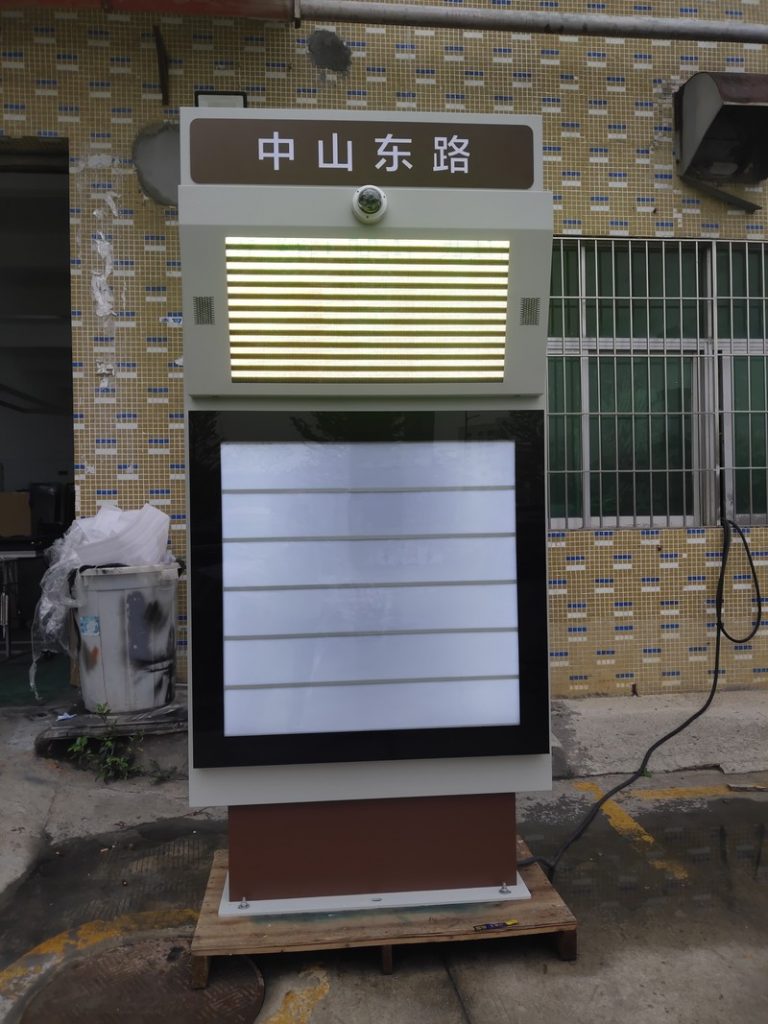
Discussions among commercial project managers regarding outdoor digital signage kiosks consistently reveal identical frustrations: displays unreadable in daytime sunlight, water and dust leaking into enclosures, and chassis metal rusting and warping within two years of deployment.
Examining these failures reveals that the warning signs existed during procurement. Anyone can write impressive figures on a specification sheet; the challenge lies in verifying whether those claims represent authentic engineering. Below is an engineering guide detailing what to ask and how to verify quality across common failure points.
Outdoor digital signage must withstand intense solar radiation, driving rain, atmospheric sand, and coastal salt spray. The core engineering paradox is: achieving daylight sunlight readability requires high panel luminance; high luminance generates substantial internal heat; yet the enclosure must be tightly sealed against rain and dust, trapping heat inside. Luminance, cooling, and weatherproof sealing naturally conflict. Skimping on any single factor will cause rapid hardware failure in the field.
Consequently, buyers must evaluate how well the complete system balances optical brightness, thermal cooling, and protective sealing.
Luminance is the first parameter buyers inspect, and the most susceptible to inflated claims.
First, clarify measurement benchmarks: Does the quoted nit figure describe raw LCD panel output, or actual measured luminance of the completed kiosk after optical transmission through protective tempered glass and anti-glare coatings? Optical glass and air gaps naturally absorb light, meaning finished kiosk luminance is lower than raw panel ratings.
Second, verify thermal brightness stability: Many displays power on brightly, but as internal heat accumulates, thermal protection systems automatically slash brightness by 30% to 50%—dimming right when peak midday sun demands full power. Inquire: Does the unit maintain rated luminance continuously under high ambient temperatures without thermal dimming?
The most dependable verification is evaluating a physical sample unit in target outdoor daylight, backed by accredited third-party optical test reports.
Datasheets frequently advertise ‘IP65 Ingress Protection,’ but the rating number is merely the starting point.
First, clarify coverage scope: Does the IP rating apply to the entire integrated kiosk assembly, or only the bare LCD module? Water leaks occur primarily through cable glands, cooling vents, and rear door seams rather than the glass face.
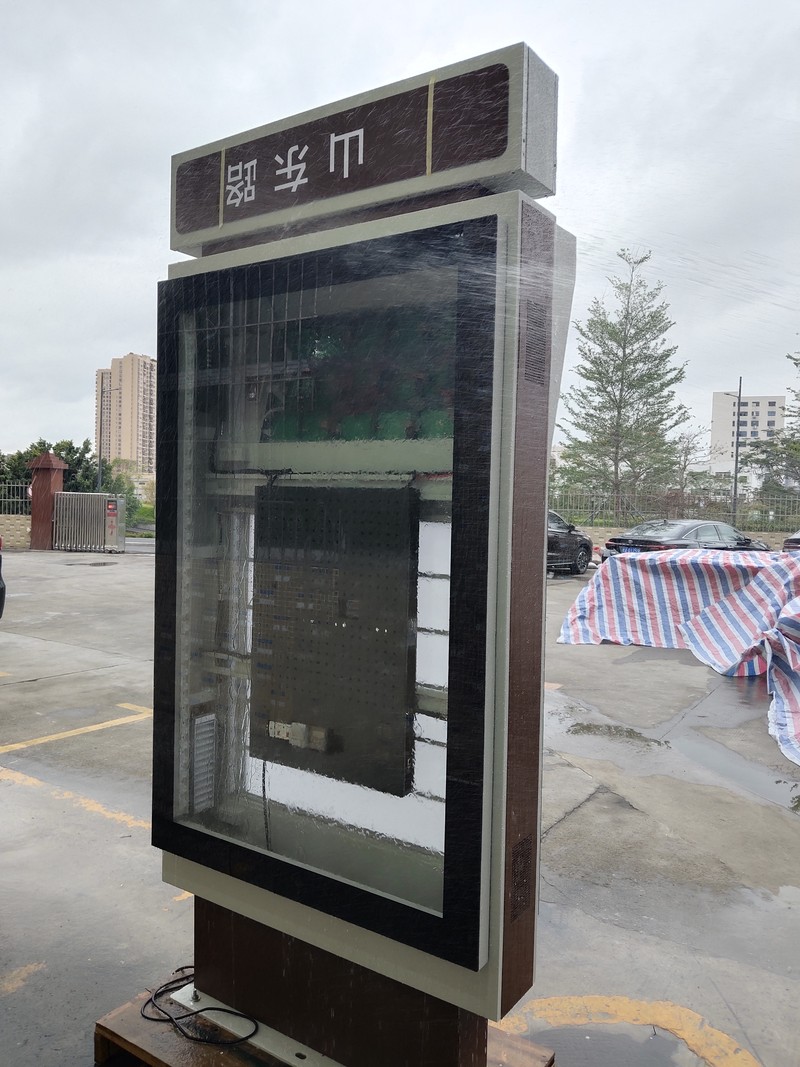
Second, verify accredited test documentation: Is the IP certification an unverified marketing claim or supported by an accredited laboratory test report specifying water-jet pressure and duration?
Finally, inspect physical sealing details: EPDM rubber gasket resilience, watertight cable gland grips with downward drip loops, and louvered cooling vents that facilitate convective airflow while baffling driving rain. These engineering details can be observed on physical units.
Chassis enclosures that rust prematurely typically suffer from thin sheet metal, crude surface preparation, or cheap paint finishes.
Clarify structural metallurgy: What metal is used (galvanized steel or aluminum extrusion) and what is the sheet thickness? What multi-stage anti-corrosion finishing is applied (e.g., zinc phosphating, electrostatic architectural powder coating)? How are vulnerable points—such as welded corners, cut edges, and fastener holes—treated against rust?
For coastal deployments, verify salt-spray corrosion test credentials, requesting test standards (e.g., ASTM B117) and exposure durations. Suppliers claiming ‘excellent rust resistance’ without testing data should be approached with caution.
Inspect physical sample units: evaluate metal rigidity, examine welds for burrs, and verify smooth, uniform powder coating.
Thermal management governs operating lifespan, yet is difficult to judge from a brochure alone.
Investigate internal cooling architecture: Does the unit utilize natural convection, forced-air cooling, or air-to-air heat exchangers? How is the internal airflow duct engineered, and are intake vents baffled against dust and rain? Do cooling fans feature automated fault detection to alert administrators of fan stalls? At what internal temperature threshold is thermal protection triggered, and how much does brightness drop?
Confirm rated operating temperature limits under full-load brightness. In cold regions, verify whether low-temperature boot-up heating is incorporated. Crucially, a high fan count does not guarantee effective cooling; aerodynamic internal duct design matching thermal wattage is what matters.
Deployed in unattended public streets, parks, and bus stops, displays face real risks of vandalism and tampering.
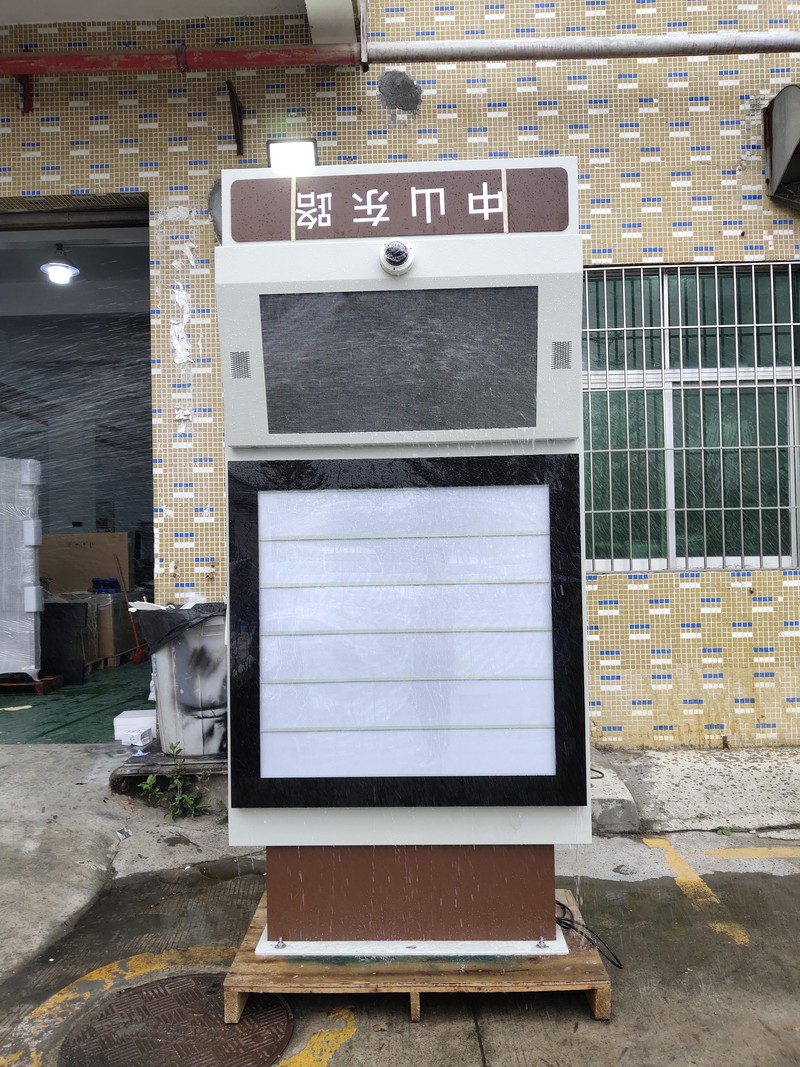
Verify structural anchoring: Are foundation anchor bolts tamper-resistant? Do rear service doors feature industrial multi-point cam locks? Does the unit incorporate chassis intrusion detection or vibration alarm sensors connected to CMS software?
Physical security measures add manufacturing cost; balance anti-vandal features against the specific risk profile of your installation location.
Effective procurement turns verbal claims into verifiable proof:
Require written technical specifications rather than verbal assurances. Demand accredited third-party test reports, verifying report dates, test conditions, and model numbers. Request physical evaluation units for on-site field testing under real summer heat or rainfall. Request client reference installations operating continuously for over twelve months in matching climates. Finally, anchor warranty coverage, service response times, and spare parts availability in binding contractual agreements.
Is higher luminance always superior for outdoor digital signage? No. Luminance must match ambient conditions; excessive brightness at night causes glare, accelerates backlight aging, and wastes electricity. Prioritize automated dimming that modulates brightness dynamically.
Does an IP rating guarantee worry-free all-weather reliability? Not entirely. IP ratings verify resistance to water spray and dust, but do not prevent air-breathing condensation. Sound installation, elevated plinth mounting, and internal climate control are equally vital.
Do sheltered semi-outdoor locations require full outdoor kiosks? Not necessarily. Under deep canopies sheltered from direct rain, solar radiation, and extreme temperatures, semi-outdoor high-brightness displays provide a cost-effective alternative.
How can buyers avoid suppliers with inflated specification claims? Demand physical sample units, inspect accredited third-party test reports, verify testing conditions, and consult existing client references in matching climates.
Successful outdoor digital signage procurement depends not on who presents the most attractive datasheet, but on whose engineering can be verified. Methodically auditing luminance benchmarks, IP sealing, anti-corrosion metallurgy, thermal cooling, and physical security—backed by physical testing and client references—ensures you steer clear of costly pitfalls.
ZXTLCD specializes in commercial-grade LCD stretched bar displays designed for retail shelving, service counters, pedestrian corridors, and showcase window interiors. If your project involves elongated commercial signage, share your installation dimensions, site conditions, and unit requirements with us to assess the optimal solution. Official website: www.outdoorlcddisplays.com/” target=”_blank” rel=”noopener”>www.outdoorlcddisplays.com
If you are sourcing high-reliability outdoor digital signage hardware, consider these commercial specifications:
ZXTLCD provides comprehensive ODM/OEM manufacturing for outdoor displays—including sunlight-readable brightness up to 4000 nits, IP65/IP66 weatherproof enclosures, intelligent temperature management, and integrated remote CMS.